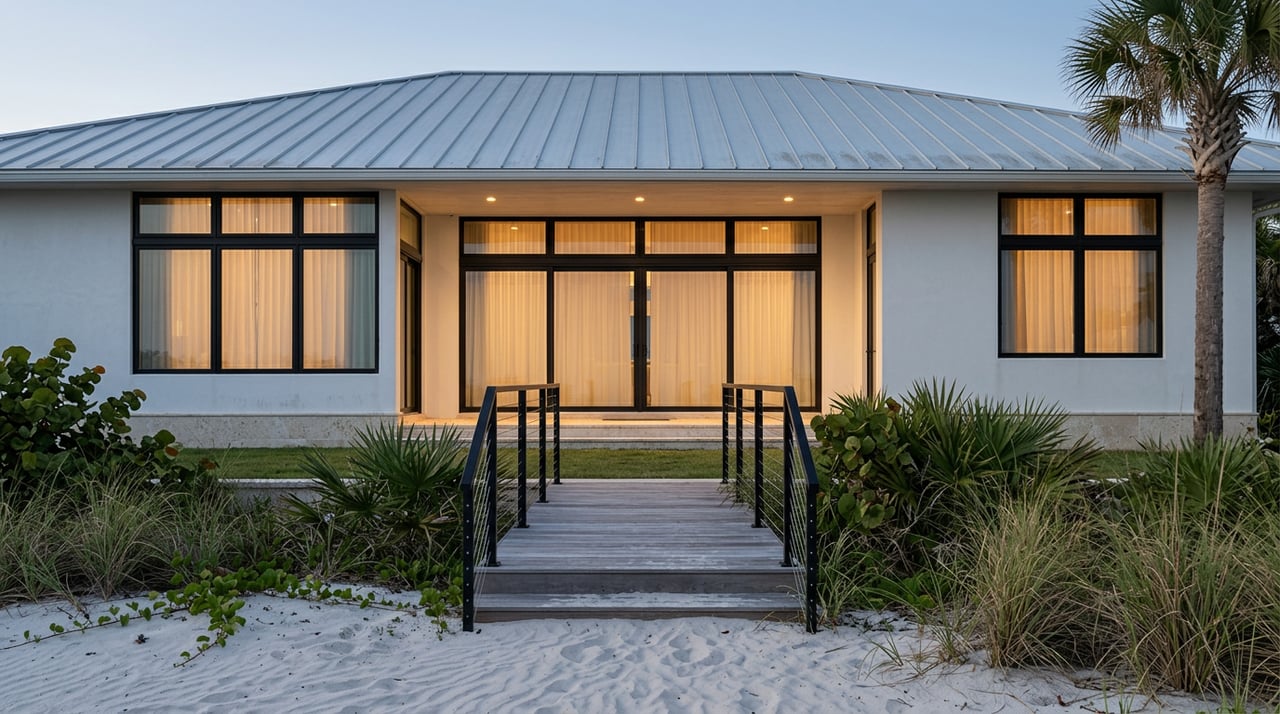
By the time the sun clears the mangroves on the bay side, Mote Marine Laboratory's Sea Turtle Patrol has already walked past your seawall. They started at first light, scanning for the drag marks that mean a female loggerhead came ashore overnight, laid a hundred eggs somewhere above the wrack line, and slipped back into the Gulf before anyone with a coffee cup noticed. On Casey Key, this is what August is. The island's quietest hours are its busiest.
That quiet is the point. Casey Key has no commercial strip, no beachfront hotels throwing light at the water, and a single road running its length. The same absence of development that makes a home here feel like a private world is also what makes the island one of the most productive stretches of nesting habitat between Longboat Key and Venice. The trade-off is small and specific: residents inherit a set of nightly habits during nesting season that carry more weight here than they would almost anywhere else on the Gulf Coast.
What Mote's Patrol Is Actually Doing at Your Property Line
The season on paper runs May 1 through October 31, but the Sea Turtle Patrol began its annual monitoring efforts on April 15, two weeks before the technical start of sea turtle nesting season on May 1. This year the first documented nest, a loggerhead, was reported on Venice Beach on Monday, April 27, roughly a mile south of Casey Key's southern tip.
The mechanics from there are consistent. From April 15 through October 31, the Sea Turtle Patrol, now in its 45th year, conducts daily surveys of Sarasota County's 35 miles of nesting beaches, from Longboat Key to Venice, scanning the sand each morning for signs of nesting activity and documenting each nest with care and precision. Nests get marked with yellow stakes and flagging tape. That yellow tape you see near the dunes in front of the Key's older residences is not decorative and not temporary. It is a working data station.
Behind the patrol sits a small workforce. Approximately 300 volunteers assist Mote's team of biologists and interns with daily monitoring of beaches. 35 miles of beaches are monitored from Longboat Key through Venice. Casey Key's roughly eight miles of shoreline are a meaningful share of that total, and because the island has no public parking north of North Jetty and no resort footprint at all, it sees less trampling, less furniture-in-the-sand, and fewer accidental lights than nearly any other patrolled stretch.
The 716 Number
Here is the tension inside this season, and the reason your habits matter. In 2025, the STCRP reported a historic nesting season, with 5,736 total nests recorded along the 35 miles of beaches. That is the good headline. The harder one sits beside it. The depletion of seagrass, dunes, and other beachfront barriers likely contributed to another, more troubling record in 2025: 716 sea turtle disorientations, life-threatening events that occur when the creatures lose their way on the beach due to artificial lighting and other disruptions.
Read those two numbers together. More nests means more clutches of about a hundred hatchlings each. More hatchlings means more small crawls across dark sand toward what should be the brightest thing on the horizon, which is the moon on the Gulf. When a porch light, a pool cage, or a television glowing through an un-drapped slider is brighter than the water, hatchlings turn inland. That is a disorientation. It is the single mechanism responsible for that 716.
Casey Key sits inside the ordinance that governs this. Sarasota County's marine turtle protection code includes Lido, Siesta, Casey, and Manasota Keys. The rules are not abstract. From May through October, Mote's guidance is that outdoor lights visible from the beach should be shielded or off after dark, drapes closed on beach-facing glass, and beach furniture pulled back overnight.
A short checklist that covers most Casey Key homes in August:
- Amber or shielded fixtures on any beach-facing exterior light
- Drapes or shades drawn on Gulf-side windows after sunset
- Chairs, umbrellas, and paddleboards moved off the sand at night
- Sandcastles knocked down and holes filled before you leave the beach
- No flashlights, phone lights, or drone launches on the beach after dark
The last point is worth sitting with. Beachgoers should not approach nesting turtles or hatchlings, make noise, or shine lights at turtles. Flashlights, head lamps, phone lights or fishing lamps should not be used on the beach. Fireworks should not be used on the beach. Guests unfamiliar with the island will reach for a phone flashlight the moment they hear a rustle in the sea oats. The correction is easy and worth making before it happens.
The Cautious Optimism Behind the Numbers
Mote's own read on this is measured rather than triumphant. "Trying to guess how many sea turtles will come up to nest in 2026 is tricky," said Dr. Jake Lasala, who heads the Mote STCRP. "Although sea turtles typically nest in high/low cycles, just because we had a record-breaking year last year in Sarasota, does not mean that we won't see a lot of nesting sea turtles this year."
Senior biologist Melissa Macksey put the longer arc in perspective earlier this year. "It is exciting because when I first started 14 years ago, we only had about 1000 nests on our beaches. Now we have anywhere from 3,500 to 5,000 nests every year, so it is exciting to see in real time how the increase is happening." Casey Key homeowners who have owned here through that stretch have essentially watched the population recover from their own back stairs.
A Casey Key Evening That Doesn't Break the Beach
The practical corollary to all of this is that August dinners tend to happen off the sand. Cross the Blackburn Point swing bridge and the options are close and specific.
Casey Key Fish House at 801 Blackburn Point Road sits at the mainland foot of the bridge and remains the reference point. Perhaps the most iconic restaurant in Osprey and Nokomis, Casey Key Fish House brings the taste and ambiance of Old Florida to life. Pop in for a piña colada at the outdoor tiki bar, or relax on the patio with conch fritters and a grouper sandwich, and watch the boats navigate through the historic Blackburn Point Bridge.
A few minutes south, Pop's Sunset Grill puts you on the Intracoastal with live music most evenings and easy access back over to Nokomis Beach after. Farther up Tamiami Trail in Osprey proper, Local Pizza at 66 N. Tamiami Trail has become the reliable weeknight answer, with a menu that leans Italian-style rather than New York or Neapolitan. Max's Table at 115 S. Tamiami Trail covers weekend brunch. Café Evergreen holds down the daytime slot in Nokomis for anyone easing off the beach after a dawn walk.
Two new arrivals are worth watching for. Tuscany Nokomis, run by Chef Jimmy Nadell, opened a new Tuscan Ballroom with a ribbon cutting and live music earlier this year, and it has quickly become the room for a longer, dressier dinner. And Five Nine Grill & Tavern, a Bradenton fixture, is opening its second location in Osprey this summer. The owners of Five Nine Grill & Tavern at 5718 Cortez Road W. plan to open an Osprey location in the coming months. The new eatery will be located in Blackburn Point Plaza, where Indian restaurant Bay Leaf used to be, at 1092 S. Tamiami Trail. Mike DeGirolamo, one of the owners, says he plans on making some changes to the 3,000-square-foot space. It will seat 120 when the restaurant opens, which he says will likely be in June. That address puts it within walking distance of the bridge, which for Casey Key residents means one more option that does not require driving into Sarasota proper.
If You Find a Nest, a Track, or a Wandering Hatchling
Three quick protocols worth keeping on the fridge for August and September.
A track without a marked nest. Do nothing. The patrol will find it in the morning. Do not follow the drag marks, do not shine a light, do not attempt to guess the nest location.
A hatchling heading inland. If you see any hatchlings going the wrong direction, you are asked to call Mote or FWC. Do not pick it up. Do not carry it to the water. The crawl matters biologically, and a hatchling that misses it needs a trained responder.
An injured or stranded turtle of any age. Contact Mote Marine Laboratory's Stranding Investigations Program at 888-345-2335. Outside of Sarasota or Manatee counties, call the Florida Fish and Wildlife Conservation Commission at 888-404-FWCC.
One more note that catches some newer owners off guard. Dogs should not be walked on Sarasota or Manatee county beaches, but county websites list exceptions such as Brohard Paw Park in Venice. Casey Key's shoreline is not one of the exceptions.
The Season, in a Sentence
The island's central luxury and its ecological importance are the same fact told twice. A Casey Key that stays dark, low, and undeveloped is the Casey Key where 100-year-old species keep returning to lay eggs above your seawall. August is the month when that connection is most literal, and the smallest choices, the drapes, the porch fixture, the sand hole your grandchildren dug on Sunday afternoon, are the ones that add up.
If you are thinking about a home on Casey Key or already own one and want a quieter conversation about how the island's rhythm shapes long-term value here, the team at Kim Ogilvie knows this shoreline block by block. Let's Connect.