Tara Edling's family had just moved into a new home on North Drive when the neighbors gave her the warning. She was planning her first Halloween in Cherokee Park after relocating from Harbor Acres, where her family lost their home and their old Halloween decorations to hurricane season the year before. She figured she knew how to scale a display. The neighbors told her otherwise: think three times what you're thinking, then go bigger. So she did. By the time trick-or-treaters reached 1752 North Drive last October, they walked through a gate into a fog-filled graveyard with a Headless Horseman standing watch, the kind of setup that turns a front yard into a small production.
That warning is not neighborhood bravado. It is a fairly accurate description of what happens on this particular set of streets once the sun goes down on October 31, and the reason has less to do with Halloween spirit than with a set of decisions a Scottish silk merchant made about a century ago.
The Lot Lines Do the Heavy Lifting
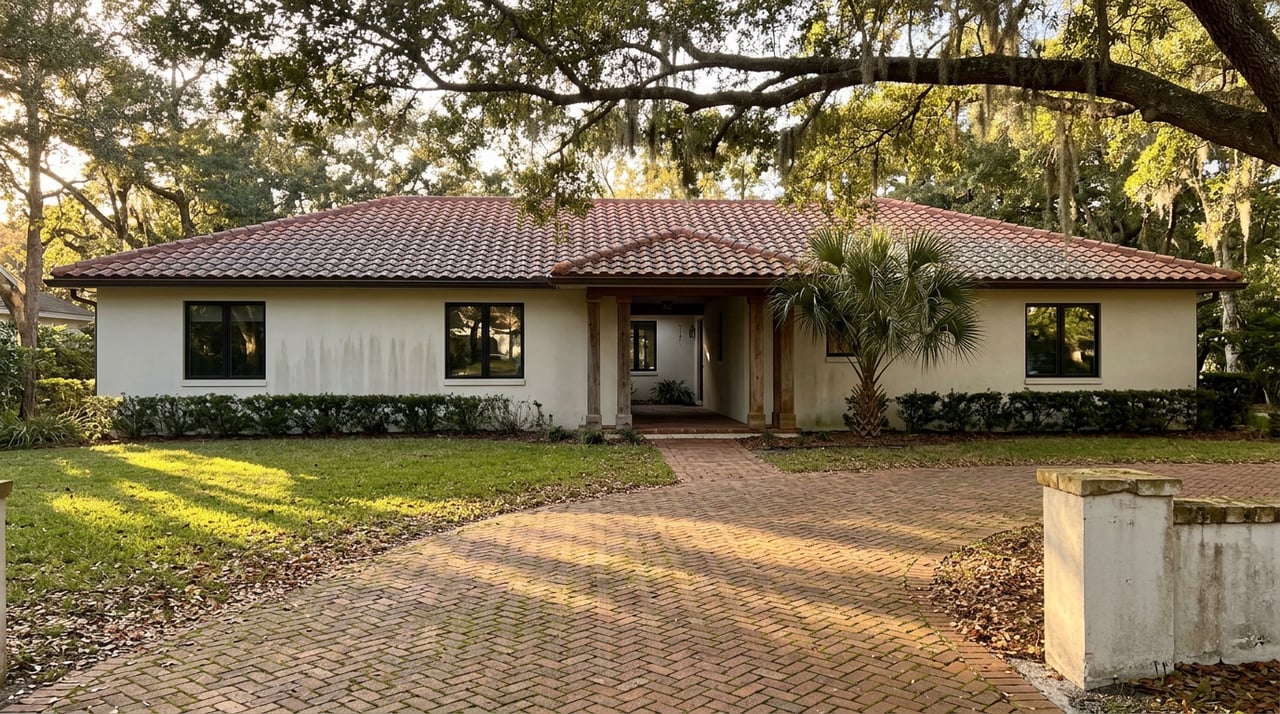
Cherokee Park was platted in 1926 by James C. Brown, who bought the land at what was then the southern edge of Sarasota during the Florida land boom. He wrote the original deed restrictions to require a minimum construction value on every lot and, more importantly for how the neighborhood functions today, he set the parcels large. Cherokee Park's home sites still run from about a third of an acre up to 1.6 acres, which is generous by any Sarasota standard and enormous compared to a typical postwar subdivision.
That lot size changes the physical experience of trick-or-treating in a way most residents feel without naming. Fewer than 100 homes sit inside the neighborhood boundary, spread across streets with wide setbacks and long driveways. A block that would hold fifteen or twenty houses elsewhere might hold half that many here, but each one gets a full approach. A driveway becomes a staging ground instead of a formality. The distance between porches is exactly the kind of gap that invites a fog machine, a gate, a full graveyard scene, because there is room for it and because the walk to the next house takes long enough that a half-hearted display looks thin by comparison.
No Fences Up Front, By Design
Brown's original deed restrictions did something else that still shapes the neighborhood: they required masonry construction and pushed fences and outbuildings to the rear of the lots. Front yards in Cherokee Park have stayed open by rule since the day the streets were laid out. There is no privacy fencing chopping up sightlines block to block, no visual interruption between one lit-up entry and the next.
On an ordinary night that reads as tidy landscaping. On Halloween it means a continuous, unbroken stretch of yard after yard, gate after gate, visible the whole way down the street. A costume, a decoration, a driveway scene carries the length of the block instead of stopping at a fence line. It is part of why families outside the neighborhood make a point of driving in for the night, and why longtime residents describe it less as trick-or-treating and more as a walking block party that happens to end in candy.
The Oaks Were Always Going to Help
None of this would carry the same weight without the tree canopy that has defined Cherokee Park since Brown's era. The heritage oaks lining North Drive, South Drive, and Cherokee Drive are mentioned in nearly every account of the neighborhood, usually as an aesthetic detail, the kind of line that shows up in a listing description. What those descriptions leave out is what the canopy does specifically after dark in late October, when string lights and fog machines sit under a ceiling of branches instead of open sky. The same trees that make an afternoon drive through the neighborhood feel unhurried are doing quiet structural work on Halloween night, framing every display from above instead of just lining the street.
"We thought it was big, but then the neighbors basically told us, think three times what you're thinking. So then we went bigger."
Nobody Runs This
Cherokee Park has an active homeowners association that organizes its own calendar of holiday gatherings and potlucks throughout the year. Halloween is not one of them. There is no sign-up sheet, no assigned route, no committee deciding who decorates what. The tradition runs entirely on word of mouth, which is exactly how Edling learned what to expect: not from a flyer, but from a conversation with the people next door.
That informality is part of what makes the night what it is. Last year's crowd included Karen and Paul Chapman greeting trick-or-treaters dressed as zebras after a recent trip to Africa, a ten-year-old named Elliott Friedman working his way down a driveway with a full bag, four-year-old Julian Flores tearing past on a bike, and a cluster of ten-year-olds trading candy in the street the way kids have always traded candy in the street. A group dressed as skeletons gathered under one of the oaks. Nobody organized any of it. The neighborhood's own layout did the organizing decades before anyone showed up in a costume.
A few things worth knowing if you live nearby and haven't fully clocked the scale of it:
- The heaviest foot traffic runs along North Drive, South Drive, and Cherokee Drive, the neighborhood's original platted streets and still its main arteries on Halloween night.
- This year Halloween falls on a Saturday, October 31, 2026, which tends to bring the street to life earlier in the evening than a weeknight would.
- There is no official start time or route. The night begins whenever the first porch light goes on and builds from there, block by block, the same way it always has.
Brown platted generous lots and open front yards in 1926 because he was trying to sell home sites in a boom market, not because he was thinking about trick-or-treaters. A hundred years later, the same decisions are why Cherokee Park empties its candy bowls faster than almost anywhere else west of the Trail, and why a family who lost everything to a storm the year before could move in as strangers and still get told, correctly, to go bigger than they thought.
If you're curious about what else makes this stretch of Sarasota work the way it does, from the streets themselves to the homes behind the oaks, the team at Kim Ogilvie Group spends its time paying attention to exactly that. Let's Connect.